
Published September 17, 2026
The Aftermath of Devastation: What Happened to Doty Island’s Housing Market?

The Aftermath of Devastation: What Happened to Doty Island’s Housing Market?
On July 27, 2026, Doty Island changed in a matter of minutes.
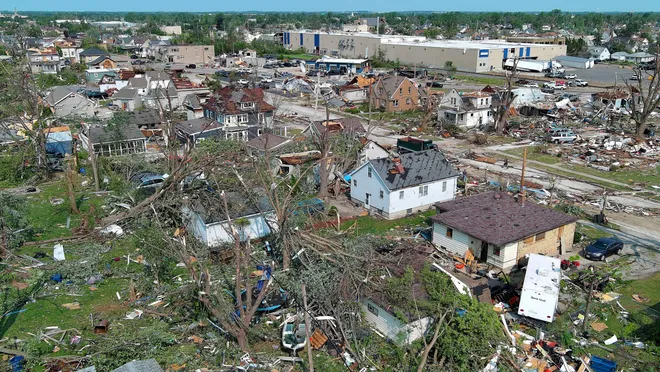
The tornado that moved through the Fox Valley was ultimately classified as an EF3, with winds estimated at up to 140 miles per hour. Across Menasha and the surrounding communities, homes were damaged, trees were uprooted, power lines came down, and entire streets were left looking almost unrecognizable compared with the morning before. Doty Island was among the areas that felt the storm's impact.
But as the cleanup began, I found myself thinking about something beyond the immediate damage.
What happens to a neighborhood after something like this?
Doty Island has always felt a little different from the rest of the Fox Valley. Even though it is part of Neenah/Menasha, it has developed its own identity and, in my experience as a Realtor, its own little niche within the local real estate market.
There is something about the island that people are drawn to. The tree-lined streets. The proximity to the water. The parks. The older homes. The feeling that you're tucked away from everything while still being right in the middle of the Fox Cities.
That's part of what makes Doty Island special.
And after the tornado, I couldn't help but wonder: with so many trees gone and some of the island's parks and properties damaged, would it still feel like Doty Island?
Would buyers still see the same charm?
Would people still want to live there?
And perhaps most importantly for homeowners, what would happen to the real estate market?
Those questions became even more relevant in the weeks after the storm. As a Realtor working in the area, I started hearing more questions from people who were trying to understand what the tornado could mean for property values and buyer demand.
I didn't really want to speculate.
So I decided to look at the numbers.
Looking for an Early Answer
I pulled the sales data for the entire Doty Island market and looked at several months leading up to the tornado before comparing them with the first month afterward.
What I found wasn't a perfectly straight line. And honestly, that's probably what you would expect from real estate.
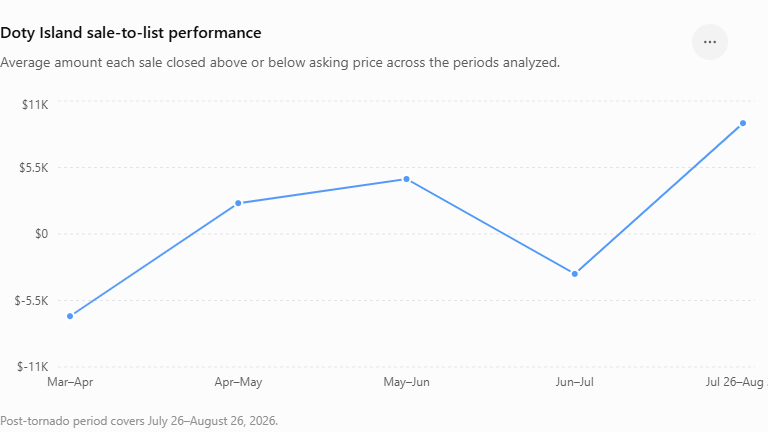
The market had already been moving around before the tornado. Earlier in the spring, homes were generally selling around or slightly below asking price. As spring turned into summer, that shifted, with homes more consistently selling above asking, this is all to be expected.
Then, just before the tornado, something interesting happened: homes were selling extremely quickly. Only three sales occurred during that period, but the median time on market was just six days.
That doesn't necessarily mean the market was suddenly stronger than ever. It was a very small sample. But it does give us some context for what happened next.
Then came the tornado.
From July 26 through August 26, six homes were sold on Doty Island.
That number immediately stood out to me.
The previous periods I looked at had three or four sales each. The first month following the tornado had six.
But the more interesting discovery came when I looked at what those homes actually sold for.
Buyers Were Still There
Those six properties collectively sold for approximately $55,000 above their asking prices.
That's roughly $9,000 above asking per home on average.
And when I compared that with the months before the tornado, it became pretty clear to me that buyers had not simply disappeared from Doty Island.
In fact, the first month of sales after the tornado produced the strongest above-asking performance of any of the periods I analyzed.
That's important.
Because if you're a homeowner on Doty Island, one of the natural fears after an event like this is that buyers are going to look elsewhere.
Maybe they'll decide they don't want to live in an area that was just hit by a tornado.
Maybe they'll see the damage and assume property values have changed dramatically.
Maybe the character of the neighborhood has changed enough that it no longer feels like the place they wanted to buy.
The first month of closed sales doesn't show buyers disappearing.
It shows homes continuing to sell, and the homes that did sell were still attracting buyers willing to compete.
But there's an important catch.
The First Month Comes With a Big Asterisk
The six sales I looked at all closed after the tornado.
That is meaningful. The market continued to function. Transactions continued to close. Buyers and sellers continued to make it to the closing table.
But a closing date doesn't tell us when the buyer actually made their decision.
Some of these properties may have already been under contract –or had an accepted offer -before the tornado ever hit.
That matters.
A buyer who agreed to purchase a home before July 27 wasn't necessarily making the same decision as someone who walked into a showing in August, saw the post-tornado landscape and then decided they still wanted to buy on Doty Island.
There is another piece of context here as well. Under the standard Wisconsin residential offer provisions addressing damage between acceptance and closing, damage of 5% or less of the purchase price generally does not give the buyer the same options as more substantial damage. Depending on the circumstances and the contract, the seller may be required to repair and restore the property. In other words, a tornado occurring between an accepted offer and closing doesn't automatically mean the transaction gets renegotiated or falls apart.
So while those six post-tornado closings are certainly part of the story, I don't think it would be fair to say that all six represent buyers who saw the aftermath of the tornado and then consciously chose Doty Island anyway.
And that's an important distinction.
The numbers tell us something, They just don't tell us everything.
So What Do We Actually Know?
What became clear to me after looking through the data is that the first month following the tornado did not show the Doty Island real estate market coming to a stop.
Six homes closed.
Those sales collectively came in about $55,000 above asking.
And the average sale was roughly $9,000 above its list price.
That's a pretty remarkable amount of activity considering what the neighborhood had just experienced.
But I don't think we should take that and declare that Doty Island has already recovered.
We're simply too early.
The real test will be what happens with the homes that are listed, shown, negotiated and purchased after the tornado.
Those transactions will give us a much clearer picture of how buyers are actually responding to the neighborhood in its current state.
And that's what I'm going to be watching.
The Part You Can't Measure in a CMA
There is also something about Doty Island that a CMA (comparative market analysis) can't really measure.
You can measure sale prices.
You can measure days on market.
You can measure inventory and the number of homes that are sold.
But you can't put a number on the feeling of driving through the neighborhood on a summer evening, seeing mature trees over the streets, being minutes from the water, or having parks and quiet residential streets tucked into an area surrounded by the rest of the Fox Cities.
That's the part of Doty Island that makes it a unique little real estate market.
And that's why I think the question of recovery is bigger than property values.
Does Doty Island still have the same charm?
A lot of the trees that helped define the island are gone. Some public spaces were damaged. Many homeowners are still dealing with repairs, cleanup and the aftermath of the storm.
But neighborhoods aren't defined by trees alone.
They're defined by the people who live there, the homes they maintain, the streets they walk, the businesses they support and the reasons they chose to live there in the first place.
And, at least from what the first month of sales is showing us, people still want to be there.
This Is Only the First Chapter
I don't think we can answer the full question yet.
And honestly, that's what makes this interesting.
Six months from now, I'm going to run this analysis again.
By then, we'll have a much larger pool of sales to look at. More importantly, we'll have more transactions that began entirely after the tornado. We'll be able to see how buyers responded once the initial shock had passed and the neighborhood's new reality had become more familiar.
We'll look at sales volume, sale prices, days on market, inventory and how closely homes are selling to their asking prices.
We'll also be able to start answering a question that this first month simply can't answer:
Did buyer demand actually remain strong once people were making their purchasing decisions in the post-tornado Doty Island market?
For now, I think the first month gives us an interesting starting point.
The tornado changed the physical landscape of Doty Island dramatically. But the first month of closed sales suggests that the real estate market itself did not simply disappear.
There is still a lot of rebuilding ahead.
There is still a lot we don't know.
And there is still a neighborhood figuring out what it will look like next.
But maybe that's ultimately what makes this worth watching.
Doty Island won't look exactly the way it did on July 26.
The question is whether, as it rebuilds, it can retain the character that made people want to call Doty Island home in the first place.
That's something I'll be watching - and I'll be back in six months to see what the numbers tell us then.
If you’re thinking about buying or selling on Doty Island, or anywhere in the Fox Valley, I’m always happy to be a resource. Real estate is local, and having someone who understands the market can make a big difference. As always, if you need a helping hand, I'm here to help.
